
Indian American Leadership Initiative President Kathy Kulkarni and IALI Vice President Anurag Varma, who had prepared for over three months to put together the organization's national convention, have reason to smile.

Indian-American scientist Amit Kshatriya's journey from watching rocket launches in Houston to becoming NASA's Associate Administrator is a testament to his dedication and expertise in space exploration.

India too can rise to the top if the 1.4 billion Indians back home are given better opportunities to use their innate talent and capacity to work hard, with right incentives in a more meritocratic rules-based system, asserts Ajay Chhibber.

US Vice President JD Vance on Sunday generated significant online traction after making a light-hearted reference to two "very, very important" Indian and Pakistani people in his life - his wife Usha Vance and Pakistani Army chief Asim Munir, on the sidelines of the US-Iran diplomatic deliberations in Switzerland.
In conversation with Aziz Haniffa, Indian-American community leaders from both sides of the political spectrum evaluate United States President Barrack Obama's first year in office.
The Indian American Leadership Initiative and Democratic Party activists and political operatives, have rounded up Mike Pompeo, Republican Congressional candidate in Kansas' District 4, for using Twitter to direct his followers to a blog posting, which he said would be 'a good read' that attacks his Democratic opponent Raj Goyle in a most vile, racist and bigoted manner.

The question nobody seems to ask is why a democracy should be silent when many of its citizens are concerned about the way the US is deviating from its traditional ways of consultation, cooperation and collaboration and moving away from traditional allies, asks Ambassador T P Sreenivasan.

If one has to compare the tenures of the two prime ministers one must credit Nehru with laying the foundations on which Modi is building a grand edifice, asserts Colonel Anil A Athale (retd).

Through his commitment to democratic norms, debate, dissent and constitutionalism, Jawaharlal Nehru helped ensure that parliamentary democracy took deep root in independent India. Utkarsh Mishra evaluates Nehru's 17 years as India's first prime minister, examining his role in nation-building, democratic institution-building, economic planning, scientific advancement and foreign policy.

The United States Central Command confirmed that the USS Rafael Peralta intercepted an Iranian-flagged ship, enforcing a maritime blockade against Iran. The US military is prepared to resume major combat operations if ordered by the President.

In many must-win battleground states, Indian Americans comprise a substantial and potentially decisive share of the electorate: 190,000 potential voters in Florida, 120,000 in Michigan, 170,000 in Pennsylvania, 150,000 in Georgia, 110,000 in North Carolina, 165,000 in Virginia, and nearly 470,000 in Texas.

'We were in a heavily nuclearised environment. China had tested for Pakistan in the 1980s and helped their missile programme stay just one step behind us.'

Sri Lanka's response to the Easter attacks has been slow and politically contested, unlike India's swift institutional reforms after the 2008 Mumbai terror attacks, observes Colonel R Hariharan (retd).

Saudi Arabia and the UAE are actively pushing Trump to take the war to its bitter finish and 'erase' Iran's presence in the geopolitics of the region. Simply put, the two most powerful Sunni Arab oligarchies are on the same page as Israel. Such interference increases the risk of a breakdown in dialogue between the US and Iran, points out Ambassador M K Bhadrakumar.

The LPG squeeze on India's restaurant sector is the quotidian face of a deeper crisis.

When everyone has footage and no one can verify it, the loudest voice wins, notes Prem Panicker who begins a daily blog on the War in the Middle East.

'The next two to three weeks will not be decided in Washington.' 'They will be decided in Tehran, in whatever calculation Iran makes about the costs of continued resistance against the costs of appearing to have yielded.'

'The heat shield technology for re-entry vehicles was first mastered in DRDO for the Agni missile.' 'This is why the Americans were so opposed to Agni in the 1980s, unlike other missiles -- it was a re-entry vehicle.'

The question is no longer whether the war will expand. It has. The next few days will tell us whether the war stabilises around Hormuz or whether the Strait itself becomes the trigger for a far larger rupture. What to watch for over the next 48 hours is simple: Any move by the US toward direct naval control of the Strait; any credible Iranian attempt to disrupt or mine shipping lanes and, critically, whether energy infrastructure in the Gulf continues to be targeted.If those lines are crossed in tandem, the war will no longer be containable within the region.

The pause gives the US time to breathe, to regroup, to move its expeditionary force into position without risk of interception along the way. It gives Iran nothing -- on the ground, attacks against its infrastructure continue apace. Prem Panicker in his must read daily blog on the Gulf War.

'Trump had done a deal with the current regime minus Maduro. The current regime is giving Trump entry into Venezuelan oil. They are obeying him and doing whatever he says.' 'They are happy because they have saved their heads by sacrificing only two, Maduro and his wife. Thousands of Venezuelan military leaders would have been jailed or killed in American action had Maduro stayed in power.'

Five longtime Republicans -- K V Kumar, Puneet Ahluwalia, Suhail Khan, Ajay Kuntamukkala and Harry Walia -- have been named to the GOP's Asian Pacific American Advisory Council.

The Indian American Leadership Initiative, founded by political activist Varun Nikore a decade ago to promote Indian-American participation in the mainstream political process and to support the community's candidates at the local, state and national levels, formally launched its political action committee on Capitol Hill in September-end.
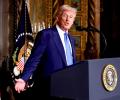
In what is seen as a U-turn, US President Donald Trump appeared to defend the H-1B visa programme to bring talent from across the world, saying a foreign investor cannot pull people off an unemployment line, who haven't worked in five years, and start making missiles.
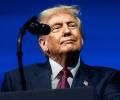
Indian professionals, including technology workers and physicians, are among the largest cohort of H-1B visa holders.

A US Homeland Security official says America will continue using the H-1B visa programme, emphasizing integrity and vetting, while highlighting increased naturalization rates under the Trump administration.
State legislators of Indian-origin in the United States appeared to be divided in their support either for Senator Hillary Clinton or Senator Barack Obama -- both of whom are engaged in a bitter fight for Democratic nomination for the 2009 presidential election.

Amritsar-born entrepreneur John Nath Kapoor was arrested by the FBI for bribing doctors to over-prescribe a powerful opioid to patients.
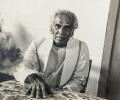
What appeared to be a generous act of friendship was, in truth, a manoeuvre within a much larger strategic game. The United States used the 1962 war not just to aid India but to test how far it could be pulled into the Western fold, points out Dr Kumar.
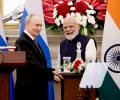
India and Russia have solidified a five-year plan to enhance their economic and trade partnership, while also addressing the ongoing conflict in Ukraine and the threat of terrorism.
The 'dean' of Indian-American legislators, Maryland House Majority Leader Kumar Barve, recalled that when he first decided to run, the community found his decision "dubious."
In the interaction that followed the discussion on 'Supporting Our Candidates: Stretching the Indian American Dollar,' former Indian-American Leadership Initiative president Jay Chaudhuri lamented the disconnect between the older and younger Indian-American generations.

Indian students at Harvard, on condition of anonymity, shared their concerns and experiences of the last few months during which the prestigious university has seen relentless attacks by the Trump administration.
Is the Democratic Party taking the Indian-American community for granted? That was one of the issues that came up during the interactive sessions at the Indian-American Leadership Initiative convention, especially considering how much the likes of Jay Goyal, Ashwin Madia, Manan Trivedi and others had to fight to secure Democratic nominations in the primary over the favorites of party insiders, in contrast to what some argued was the embrace of the GOP of the likes of Bobby Ji

While both sides have announced the decision to restart talks for a trade deal, government officials said discussions are continuing virtually.
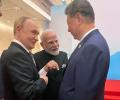
'One Chinese interlocutor said India should realise that "China can do without India, but India could not do without China", pointing to its inability to do without Chinese intermediates and components,' former foreign secretary Shyam Saran discovers on a visit to China.
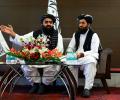
'During the 5-day visit, Amir Khan Muttaqi would have, conceivably, bumped into our powerful security agencies one way or another and some interaction would have ensued, which, in turn, can lead to future dealings.' 'Indeed, this will be the one crucial template of the Indo-Afghan relationship that Pakistan will be monitoring closely,' points Ambassador M K Bhadrakumar.
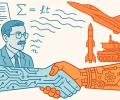
'Government officials use Gmail and ordinary phones without basic security consciousness.' 'Interoperability, especially in joint exercises with countries like the US, worries me.' 'It often means we open our systems to them, but they don't reciprocate.' 'They could have kill switches in their systems and might even be able to affect ours.'
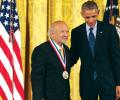
Not only did Barack Obama mention and quote Thomas Kailath in his remarks before presenting the Stanford University professor emeritus of engineering with the National Medal of Science, the President also cited Kailath as a shining example of the brilliant talent of immigrants who make invaluable contributions to the United States and the world.
It's no secret why Washington, DC-based information technology entrepreneur Rajeev Sharma has been unanimously cajoled into serving as the chair of the Indian American Leadership Initiative's advisory board.
